Do countdown timers sell more?
A countdown timer promises urgency: order in the next nine minutes or lose the deal. Before you add one, know what researchers found when they put a resetting timer in front of shoppers inside a simulated online store.
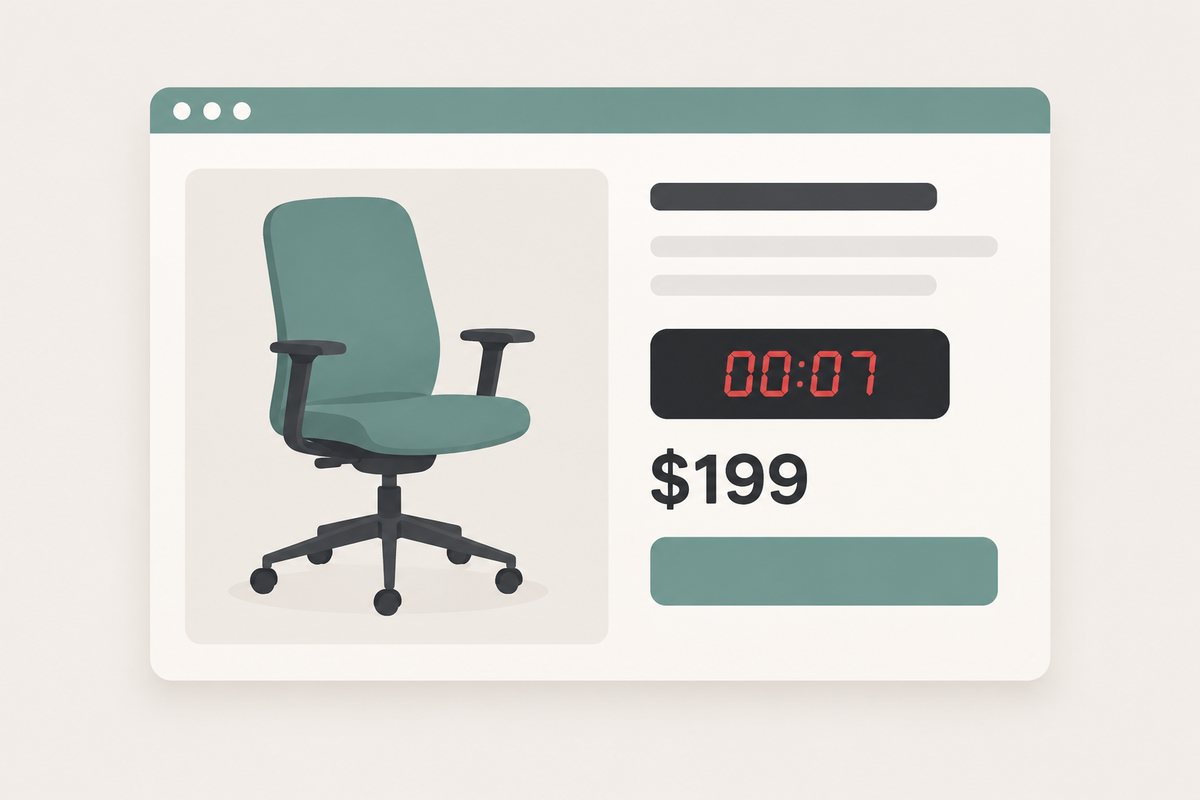
Editorial illustration, not a real storefront.
A countdown is deceptive when the offer continues after the timer reaches zero: it simply starts again, or resets when the page reloads. When researchers collected 60 countdown timers from live shopping sites, at least 27 were confirmed deceptive by that definition [1]. A timer that resets while the offer stays unchanged belongs to that group.
In a 2023 study from Radboud University, presented at the CHI conference, 245 participants shopped in a simulated online store with a fictional budget [1]. Everyone saw the same two office chairs. One group saw no special offer. A second group saw one chair reduced from $320 to $260. A third group saw the same discount paired with a deceptive seven-minute countdown resetting on each page load.
The discount worked: both offer groups chose the discounted chair significantly more often than the no-offer group. The timer, however, added no statistically significant advantage in choosing the discounted product. Asked why, almost a third of the timer group mentioned the discount. Not one mentioned the timer. A few deliberately picked the other chair because the countdown looked fake. One said: "It was the same chair so I chose the less 'sketchy' one" [1].
Fear of missing out was significantly higher with the timer than with no offer, though not significantly higher than with the discount alone. Perceived time pressure and the feeling of being steered showed no significant differences.
After the task, the researchers explained dark patterns and asked what participants thought. The answers were blunt: manipulative, unethical, immoral. One participant said: "It is an unethical and immoral practice. I would avoid shops that are using this." Another called fake countdowns "where I draw the line" [1].
These are attitudes reported after the tactic was explained, in a simulated shop with fictional money. The same caveat covers regret: over 80% of participants expected moderate or higher regret on learning that an "expired" offer never expired. The authors describe these findings as exploratory, drawn from one simulated store.
Scarcity itself is not the problem. A Journal of Retailing meta-analysis across 131 studies and 416 effect sizes found that scarcity cues increase purchase intentions on average, and that time-based scarcity works best for high-involvement products [2]. The weak case is time pressure online. A Journal of Marketing study found the positive effects of time-scarcity promotions seen in physical stores may not emerge online, where shoppers more easily recognise the tactic. It also found a partial remedy: a deadline with a real, stated reason, such as a birthday or a seasonal change, can improve the response [3].
Where does that leave the timer? In this simulation, adding a deceptive countdown to a discount produced no significant extra pull toward the discounted product. That is an absence of detected benefit in one experiment, and absence of evidence is not proof of no effect. The attitude findings sit apart: they capture what people said after the tactic was explained. This experiment did not track completed purchases in a live store; what a timer does to real orders on your store is what your own test answers, which is step 4 below.
- Remove any timer that resets while the offer stays unchanged. That is a truthfulness fix, and it does not need a test.
- Where stock is genuinely thin, say so with a real low-stock signal. Real scarcity carries the cue honestly.
- If you run a deadline, give the real reason (a dispatch cutoff, a seasonal change, a batch ending) and honour it when it passes.
- If you want urgency's upside, test it properly. Show the change to one group of visitors and keep another on the current page. Pick one primary metric before you start: completed purchases, watched alongside complaints, cancellations and returns. Decide the stopping point in advance and hold to it.
A lift in clicks alone will not tell you whether the change helped.
Humalyze studies the persuasion cues D2C storefronts display, and checks what the research behind each one actually supports. Questions about a storefront decision you are weighing: [email protected].
- Tiemessen, Schraffenberger and Acar, "Time is Ticking: The Effect of Deceptive Countdown Timers on Consumers' Behavior and Attitudes", CHI EA 2023
- Barton, Zlatevska and Oppewal, "Scarcity tactics in marketing: A meta-analysis of product scarcity effects", Journal of Retailing 98(4), 2022
- Hmurovic, Lamberton and Goldsmith, "Examining the Efficacy of Time Scarcity Marketing Promotions in Online Retail", Journal of Marketing 87(2), 2023